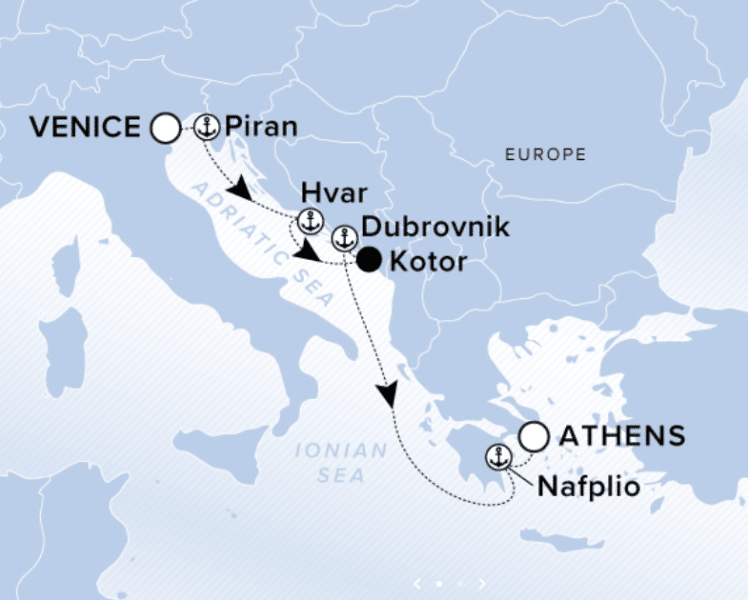
DAY 1 – VENICE
One of the most enchanting cities in the world and a UNESCO World Heritage site, Venice rises from a lagoon on more than a hundred tiny islands linked by the iconic network of canals. A romantic gondola ride provides the perfect introduction to the city, gliding underneath the Ponte di Rialto – the oldest and most famous of Venice’s hundreds of bridges – and past the ornate palaces lining the Grand Canal. The power and wealth of the Venetian empire are on display at Piazza San Marco, the city’s most splendid square, where stands the grand St. Mark’s Basilica and the Gothic-style Doge’s Palace. Priceless art collections vie for attention, including the Italian masters in the Gallerie dell’Accademia and the modern works of the Peggy Guggenheim Collection. Some of the world’s most talented glassblowers showcase their wares on the island of Murano, while the colorful shops of Burano are home to artisan lace makers.
DAY 2 – PIRAN, SLOVENIA
Set on a narrow peninsula on the coast of Slovenia is the charming coastal town of Piran, known by many as the gem of the Slovene Riviera. Half a millennium of Venetian rule has left its mark, as seen from the architecture throughout the town. A maze of narrow cobblestoned streets is outlined by colorful houses with terracotta roofs and surrounded by olive groves and pebble beaches. At the heart of the town, Tartini Square is the perfect place to grab a coffee and people watch while admiring the Gothic style Venetian house, the Teatre Piran and the harbor. Walk the medieval walls of Piran and climb the bell tower’s 146 steps for a stunning 360-degree view over Piran, Slovenian Istria, Italy and Croatia. Perched on a hill overlooking the Italian and Croatian coastlines is the Church of St. George, Piran’s prettiest church with a classic Venetian Renaissance style and beautiful stone statues. Just 25 minutes along the coast, the town of Koper offers more beautiful views and landmarks such as the 15th century Praetorian Palace.
DAY 3 – HVAR, CROATIA
Super yachts crowd the harbor and waterside bars hum with wealthy vacationers and young partiers in this posh island getaway with a laid-back Mediterranean vibe. The island of Hvar is famous for its lavender fields, vineyards, year-round sunshine and nonstop nightlife, but it’s also rich in culture and history. Near the harbor stands a Benedictine convent where nuns fashion lace as part of a 150-year-old tradition recognized by UNESCO as an Intangible Cultural Heritage. UNESCO has also recognized Stari Grad Plain, a cultural landscape that has remained practically unchanged since it was first colonized by Ionian Greeks in the 4th century BC. And let us not forget the island’s charming capital, one of the best-preserved historic towns on the Adriatic. It’s worth the climb to the ancient fortress to take in the views.
DAY 4 – KOTOR, MONTENEGRO
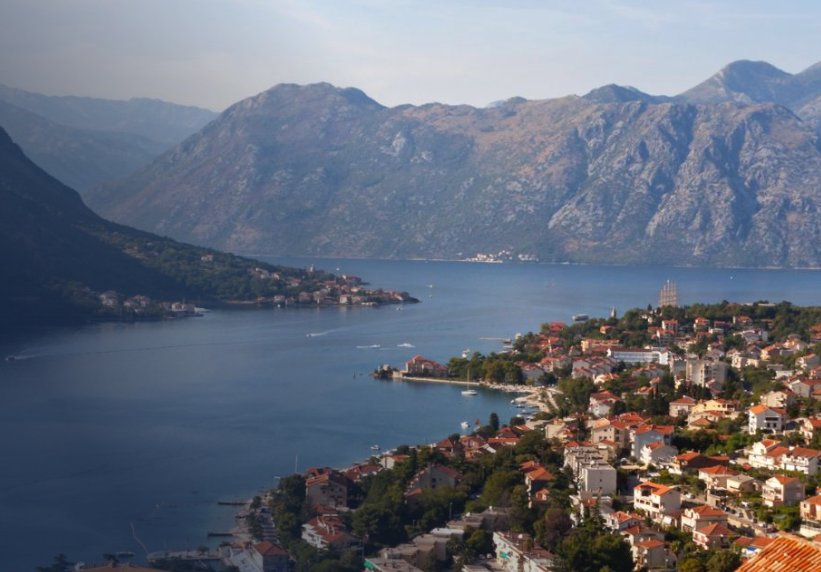
Simply arriving in Kotor is an unforgettable experience. One of the world’s most breathtaking waterways, the fjord-like Bay of Kotor follows a winding path through the forested mountains that rise on all sides of the sparkling sea. Nestled along the most inland cove are the coral-tiled roofs of Kotor, a UNESCO World Heritage site. Fortified during Venetian rule, medieval ramparts surround the Old Town, where visitors will find historic landmarks such as the 12th-century Cathedral of St. Tryphon and the Maritime Museum. The physically fit should climb the 1,350 steps to clifftop St. John’s Fortress for gorgeous views of the town and the bay. A more leisurely option would be a boat tour to the unique Our Lady of the Rocks Church, situated on a tiny manmade islet, or a drive to the charming medieval town of Budva.
DAY 5 – DUBROVNIK, CROATIA
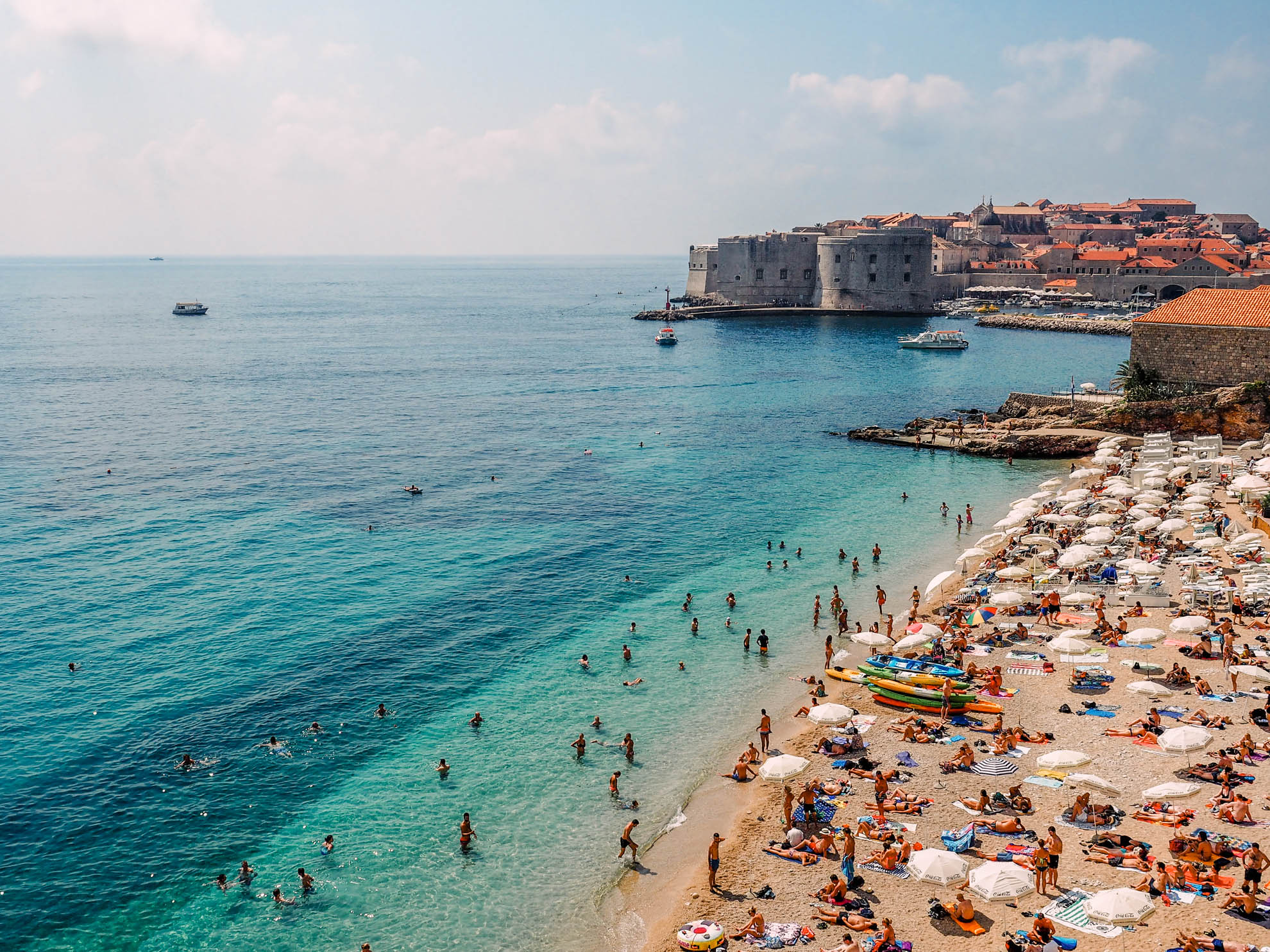
It was English poet Lord Byron who famously described the great walled city of Dubrovnik as “the pearl of the Adriatic” and George Bernard Shaw stated that “Those that seek paradise on earth should seek it in Dubrovnik.” Red tiled roofs and a backdrop of green hills contrast sharply with the spectacular blue of the Adriatic. Thick medieval walls wrap around beautiful Gothic, Renaissance and Baroque churches, monasteries, palaces and fountains. This UNESCO World Heritage site played a central role in the TV show Game of Thrones. No matter how many times you’ve been to Dubrovnik, you can’t help being inspired by the ancient ramparts that survived sieges by countless invaders for centuries and still stand proudly today.
DAY 6 – SAILING TIME
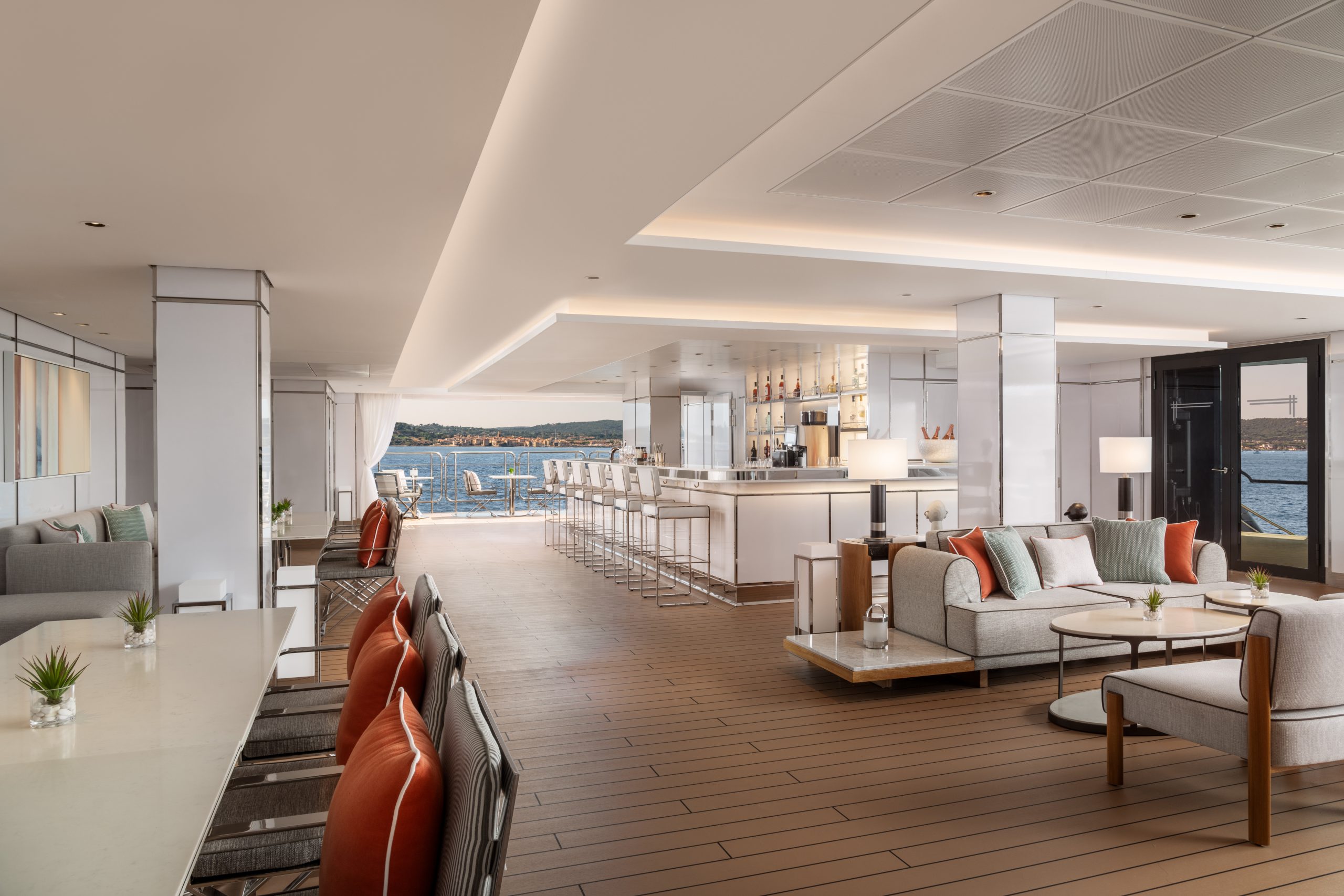
With a day at sea, enjoy the unique opportunity to unplug and relax into the unhurried life on board. Enjoy a workout with a view at the gym, indulge in a relaxing spa treatment, watch the sky transform at sunset from The Observation Lounge, or find an intimate alcove in The Living Room and lose yourself in a favorite book.
DAY 7 – NAFPLIO, GREECE
The Venetians left their mark in Nafplio. Perched on a cliff jutting into the sea, their impregnable fortress is an elegant display of Venetian might. Walk through the Old Town with its handsome neoclassical buildings and balconies dripping with bougainvillea. One of the most beautiful towns in Greece, Nafplio is also one of the most historic; its cultural roots date back to both the Argonautic expedition and the Trojan War. From here you can drive across the Peloponnese where tales from Homer’s Iliad come alive. Visit the immense beehive tomb of Agamemnon in the Bronze Age citadel of Mycenae, a UNESCO World Heritage site. Wonder at the acoustic marvel of the ancient theater in Epidaurus, another UNESCO World Heritage site, built in the 4th century BC and still in use today.
DAY 8 – ATHENS, GREECE
Athens is the cradle of the Western democratic tradition, home to a civilization as radiant as any before or since. Feel the pulse of history as you climb to the hilltop Acropolis, home to some of the city’s most renowned ancient sites. Gaze in amazement at the massive columns of the Parthenon, Pericles’ greatest monument. Admire the little Temple of Nike and the fantastic carvings of the caryatids that support a porch of the Erechtheion. At the bottom of the hill, the Acropolis Museum includes original statues of the maidens and numerous other artifacts unearthed here. Equally outstanding is the National Archaeological Museum, one of the largest in the world. In the Agora, you can walk in the footsteps of Plato and Aristotle, carry on an imaginary dialogue with Socrates and discover where Hippocrates healed and Pericles ruled. Then for lighter fare, savor the lively tavernas and twisting lanes of the Plaka neighborhood.